Industry
Part of Needles, blades and irons: how mending tools fail, and what it costs
4 honest notes on mending tools and supplies makers
Reading supply marketing: what a trademarked fiber name has to be paired with, how required information must be arranged, and what none of it tells you.
Four honest notes on mending tools and supplies makers start with labels. Dritz, Clover, Gütermann, Bohin, Tulip, and Merchant & Mills sell needles, thread, patches, and darning tools in fabric shops and online. What follows is what advertising rules require of them, and what those rules leave out.
What to take away
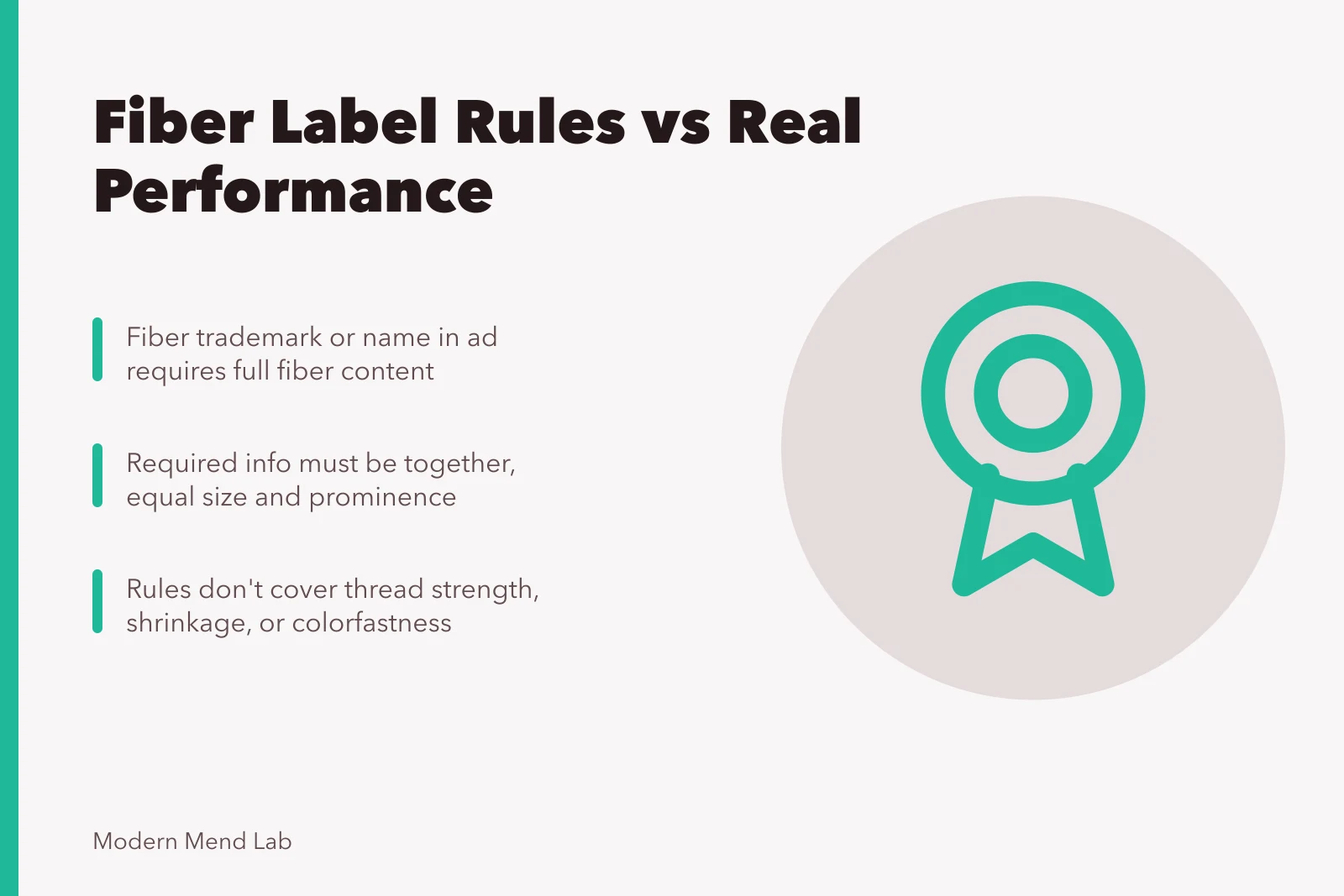
- The FTC's Textile Fiber Products Identification Act, 15 U.S.C. 70, and its advertising provisions at 16 CFR Part 303 require fiber content disclosure. That applies to any ad that uses a fiber trademark or generic fiber name.
- Those rules do not cover performance, such as thread strength or shrinkage.
- Test a small quantity of anything you buy. A label tells you what a product is, not how it behaves.
Note 1: A fiber name in a maker's listing triggers a disclosure
An ad that mentions a fiber takes on an obligation. The FTC's Textile Fiber Products Identification Act, 15 U.S.C. 70, and its advertising rule at use of fiber trademarks and generic names in advertising, 16 CFR 303.41, cover any textile fiber product.
If a listing uses a fiber trademark or generic fiber name, it must disclose the full fiber content required by the Act at least once. That applies to new cloth and to scrap and reclaimed cloth independent makers use for creative mending ideas.
Where a trademark is used for a product containing more than one fiber, the trademark and the generic name must appear in the required fiber content information, in immediate proximity and conjunction.
Needles, awls, thimbles, and darning mushrooms are not textile fiber products, so these rules do not reach them.
If you cannot audit a label, test a small quantity. Buy one spool or a quarter meter, wash it at the temperature your garments get, measure before and after, pull it to failure, and rub it against itself.
If a product page leans on a fiber name and never states full content anywhere, the seller is either not covered or not complying, and either answer tells you something. If a listing omits required fiber content, you can check or report it to the FTC at reportfraud.ftc.gov.
Note 2: Makers arrange required information, not performance data
The second rule closes the obvious loophole. Under the section on arrangement of information in advertising, 16 CFR 303.42, all parts of the required information must be stated in immediate conjunction with each other. The type must be legible and conspicuous, of equal size and prominence.
Generic names must be given for fibers present at 5 percent or more of total fiber weight.
Equal size and prominence is the part worth remembering. A large trademark above a tiny content line is exactly what the rule was written against.
Note 3: What the rules do not cover
None of this describes performance. There is no required disclosure of:
What the rules do not cover
- Thread breaking strength
- Shrinkage on washing
- Colorfastness to light or to washing
- Whether a yarn is made from new or reclaimed fiber, unless the terms virgin or new are used
- Pilling behavior
Those are the properties that decide whether a repair holds. They come from testing, either the seller's or yours.
A Dritz darning needle and a Tulip sashiko needle can both be labeled steel, yet differ in tip shape and shaft finish. A package usually lists size and quantity, not the performance data a mender needs.
Note 4: Keep a record of what you test
Keep the result in the same log you use for the rest of your stock, and the second purchase becomes a decision rather than a repeat guess.
The physical failure modes behind those tests are set out in how mending tools fail, and the surfaces you test on matter more than expected, as the cutting and pressing surfaces article explains.