Features
Mending a wool coat buttonhole: a step-by-step repair guide for US sewers
Step-by-step hand repair for a torn wool coat buttonhole: diagnosing frayed edges, rebuilding bar tacks and lips, choosing twist, and when to rebind.
What to take away
- A torn wool coat buttonhole is normally a bound opening, so the repair has to rebuild the bar tacks and the lips, not just close a gap.
- Stabilize the frayed edges first, then rebuild the stitching over them with waxed buttonhole twist in a matching color.
- Hand repair works when the wool around the opening is still sound. A missing chunk of front edge calls for a bound or machine-finished replacement.
- The finished repair should look tidy up close and invisible from arm's length. That is the standard to aim for.
Diagnosing a torn buttonhole on a wool coat
Press the buttonhole flat before you judge it. Wool nap and loose fibers hide damage, so a tear that looks small can be much wider once the surface is smooth.
Examine three areas: the bar tacks at each end, the lips along both long edges, and the interfacing behind them. A bound opening carries a raised stitched edge, and each part fails differently.
Damaged bar tacks matter most. When one pulls out, the button loads the opening on every wearing and the tear lengthens. Rebuild the bar tack even if the lips look intact.
Check the button too. A chipped plastic button or a rough horn edge acts like a saw on wool. Smooth it with fine sandpaper or swap the button before you stitch.
Note which buttonhole takes the load. On a double-breasted coat the opening at chest height wears first, so give it the closest look.
Tools and thread for a wool coat buttonhole
| Item | What to buy | Why it matters |
|---|---|---|
| Buttonhole twist | Silk twist labeled size D or E, or cotton buttonhole twist | Holds a bound edge without adding bulk |
| Hand needles | Sharps, size 7 to 9 | Short enough for small, controlled stitches |
| Beeswax | One small block | Keeps twist from fraying as you pull it through wool |
| Scissors | Sharp embroidery points | Trims fuzz without cutting structural yarns |
| Pressing cloth | Cotton or linen scrap | Lets you press wool without scorching it |
Wool responds to moisture and heat, so damp pressing between steps resets the fabric and shows the true shape of the repair.
Sourcing is its own problem in small towns. Menders in St. John's handle it with local craft suppliers, repair groups and careful shipping.
Step-by-step: rebuilding a torn buttonhole by hand
The sequence below is the short version. For the full order of work and thread costs in USD, see how to repair a torn buttonhole.
- Press the coat front over a damp cloth and work on a table, not your lap.
- Trim only fuzz and pills. Leave any yarn that still crosses the opening.
- Anchor an arm's length of waxed twist on the back, under the facing, and keep the knot inside.
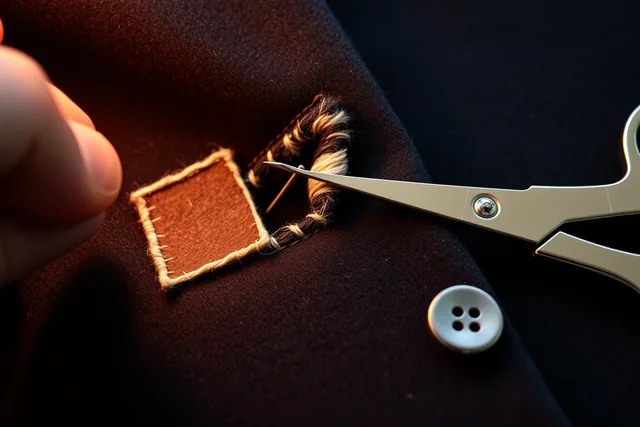
- Rebuild the weakest bar tack first with a close blanket stitch over the cut end, catching the interfacing.
- Sew the lips with small stitches taken perpendicular to the opening, spacing them to keep the bound edge even.
- Test the tension as you go. The edge should sit flat with no puckering.
- Lock the work by running the needle through the interfacing at both ends, then knot on the back.
- Press again over a cloth and let the wool cool before you button the coat.
When a bound or machine-finished buttonhole wins
Rebuild by hand when the lips are frayed but the surrounding wool is whole. That covers most everyday wear.
Choose a bound replacement when a piece of the front edge is missing, or when the buttonhole has stretched and no longer lines up with its button.
A tailor can cut a fresh bound opening from matching wool and finish it by hand. Machine keyhole buttonholes are quick on heavy coatings but hard to hide on a dressy coat.
If the job is past what you want to attempt, a repair cafe offers a second pair of hands at low cost, and Halifax repair cafe models run from pop-ups to library events.
Finishing checks and the test for done
- The bound edge lies flat and does not ripple when the coat is buttoned.
- Both bar tacks feel firm under your thumb.
- The button passes through with slight resistance, not a loose slide.
- The repair survives five button and unbutton cycles without new fraying.
- The inside facing shows no loose knots that can pull.
Visible mending is a fair finish on a casual coat, where contrast thread reads as deliberate rather than damaged.
Tenacious tape belongs on shell fabric, not here. If you mend a down jacket with tenacious tape you are sealing a nylon or polyester shell, not rebuilding a stitched opening.