Industry
Part of Denim repair methods by location: crotch, knee, hem, pocket
Denim Repair Methods: How the Fabric Changes the Repair
Denim repair methods change with the fabric: stretch denim, rigid denim, cotton shirting, linen, and wool knits each call for a different patch and stitch.
The differences described here come from published textile research and from the labeling rules, both of which are checkable. Denim repair methods start with one fact: denim behaves differently from other fabrics, and the fabric itself decides how the repair should be built.
What to take away
- Stretch denim and rigid denim need different patches. Elastane changes both stiffness and strength.
- The dyed warp means abrasion shows as fading long before a hole opens.
- Small percentages of elastane matter far more than their percentage suggests.
- Thick seam intersections are where machines and hands both fail.
The denim repair methods, and the fabric each one suits
Most denim repair comes down to a handful of approaches, and the fabric decides which ones behave.
- Hand darning:a woven grid of running stitches worked over the worn area. It stays soft, which makes it the safest choice on stretch denim, where a stiff patch pulls at the weaker weft.
- Machine darning:a dense straight stitch over the damage. Quick and strong on rigid denim; on stretch denim, guide the fabric instead of letting the machine drag it, or the repair will pucker.
- Sashiko-style reinforcement:rows of running stitch worked across a pale area before it opens. It suits stable, rigid denim and is the visible-mending version of the reinforcement patch.
- Boro-style layered patching:patch stacked on patch, stitched down flat. Best kept for heavy, tightly woven denim that will not distort under the layers.
- Reverse appliqué:a patch placed behind the worn area, with the damaged denim cut back to reveal it. Use it where the edges around the hole are still sound enough to hold stitches.
- Iron-on and fusible patches:the fastest route and the least forgiving. The adhesive stiffens the cloth without restoring its strength, so treat it as a stopgap, especially on anything with elastane.
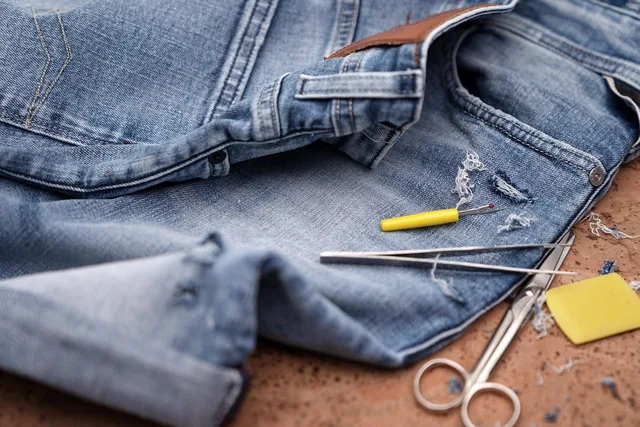
The tool list barely changes between them: a denim needle for the machine, a thimble, a sharp awl for opening seam intersections, and a flat support or darning mushroom under the work.
Elastane changes the fabric more than the number implies
Modern jeans usually contain a small proportion of elastane. Research in Journal of Textile and Apparel, Technology and Management tested how fabric weight, lycra content, and weave affect stretchable denim by measuring thickness, tensile strength, flexural rigidity, stretch, and growth.
Stretch vs rigid denim repair
Stretch denim
- Flexural rigidity
- Higher
- Weft breaking strength
- Lower
- Air permeability
- Lower
- Patch boundary
- Hard, tears weft
Rigid denim
- Flexural rigidity
- Lower
- Weft breaking strength
- Higher
- Air permeability
- Higher
- Patch boundary
- Matches fabric
It also measured elastic recovery and air permeability. Increasing fabric weight improved most comfort and performance measures, and as lycra content rises, flexural rigidity increases while breaking strength in the weft and air permeability both fall.
The repair consequence is direct. A stretch pair is stiffer in bending and weaker across the weft than a rigid pair of the same weight, so a rigid patch on stretch denim creates a hard boundary that the weaker weft then tears along.
Why a 2 percent fiber matters
Under the Federal Trade Commission's rules implementing the Textile Fiber Products Identification Act (16 CFR Part 303), a fiber present at less than 5 percent of total fiber weight is generally listed as “other fiber,” not by its generic name.
The exception: clearly established and definite functional significance at that amount. The rule cites 96 percent acetate with 4 percent spandex as its example.
Elastane in jeans is exactly that case. It is disclosed at 1 or 2 percent because at that level it changes how the garment behaves, which is the same reason it changes how the garment must be repaired.
What changes with other fabrics
Woven cotton shirting is usually lighter than denim. A close-weight woven cotton patch helps avoid a stiff spot, and small running stitches or a straight machine stitch can secure it.
Linen's woven yarns can fray at worn edges. A lightweight linen patch with its edges secured by close stitches suits this structure better than a heavy denim patch.
A wool knit stretches through its loops rather than behaving like woven cloth. Use matching wool yarn for a darn or a knit patch, and work on flat support without stretching; a rigid woven denim patch can restrict movement.
Fading is the early warning
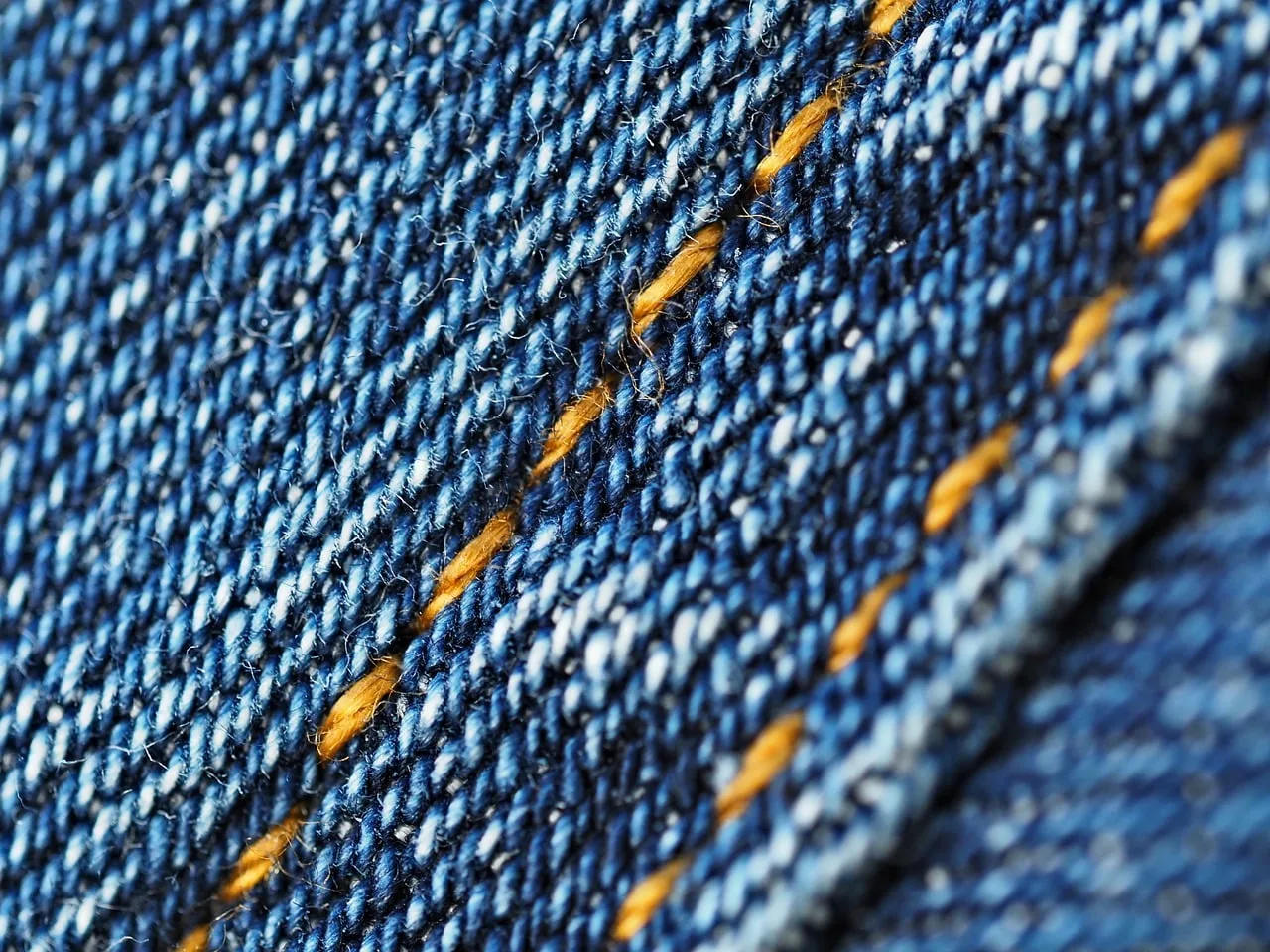
Because the warp is dyed and the weft is not, abrasion on denim shows as a pale patch well before anything opens. That pale stage is when a reinforcement patch can be added before the fabric opens, while more sound fabric remains to support the repair.
Denim wear stage repair decision
Pale but intact?
reinforce behind, no visible repair
check for white weft threads
Seam intersections
Every pair of jeans has points where four or more layers meet. Those are where hand needles bend, machine needles break, and repairs fail. Plan a patch to avoid crossing them where possible, and where it is unavoidable, work that crossing by hand with an awl to open a path first.
For denim-specific detail beyond fabric choice, see a separate comparison of denim repair approaches and the common mistakes beginners make.