Reviews
Part of Denim repair methods by location: crotch, knee, hem, pocket
Picking patch denim and thread for a jeans repair
Picking patch fabric for jeans: weight, stretch, color behavior and where pocket bags fit, plus the label tolerance that explains why blends never match exactly.
The patch decides the repair, and the thread decides whether the repair holds. Picking patch denim and thread for a jeans repair comes down to three matches, in this order: weight, stretch and how much the fabric has already shrunk.
A repair with good stitching and the wrong patch fabric fails at the boundary within a season. The usual cause is a patch stiffer than the garment.
What to take away
- Use a patch lighter than the garment, never heavier. Heavier fabric acts as a rigid plate.
- Match stretch behavior. A rigid patch on stretch denim tears the denim beside it.
- Prewashed donor denim beats new denim, because its shrinking is done.
- Pocket bags are a separate lightweight fabric and are replaced, not patched.
- Match thread fiber to the garment. Stretch denim needs polyester or core-spun polyester, not cotton.
- Size thread by Tex numberTex 25 to Tex 35 for all-purpose work, Tex 40 to Tex 60 for denim seams.
Weight
Denim weight is quoted in ounces per square yard. Standard jeans run 10 to 14 ounces, and heavy workwear runs 15 or more.
You do not need the number; you need the comparison. Hold the candidate patch against the garment, fold both, and feel which resists more. If the patch resists more, it is too heavy.
The workable order of preference is: same-weight worn denim from another pair, lighter denim, heavy woven cotton such as drill or twill, then quilting cotton for lightly stressed areas only.
Selvedge denim from Kaihara Mills in Japan, Candiani in Italy and Kuroki in Okayama sells at shops like Mood Fabrics in New York, typically $15 to $40 a yard.
A used pair from Goodwill or Salvation Army typically costs $5 to $15 and gives you fabric that has already shrunk.
Stretch
If the jeans contain elastane, the patch should too. If you cannot find stretch denim, use a fabric loose enough to move with the garment. The mismatch is worse than most people expect: the stretch garment moves under load, the rigid patch does not, and the stress lands on the four stitched edges.
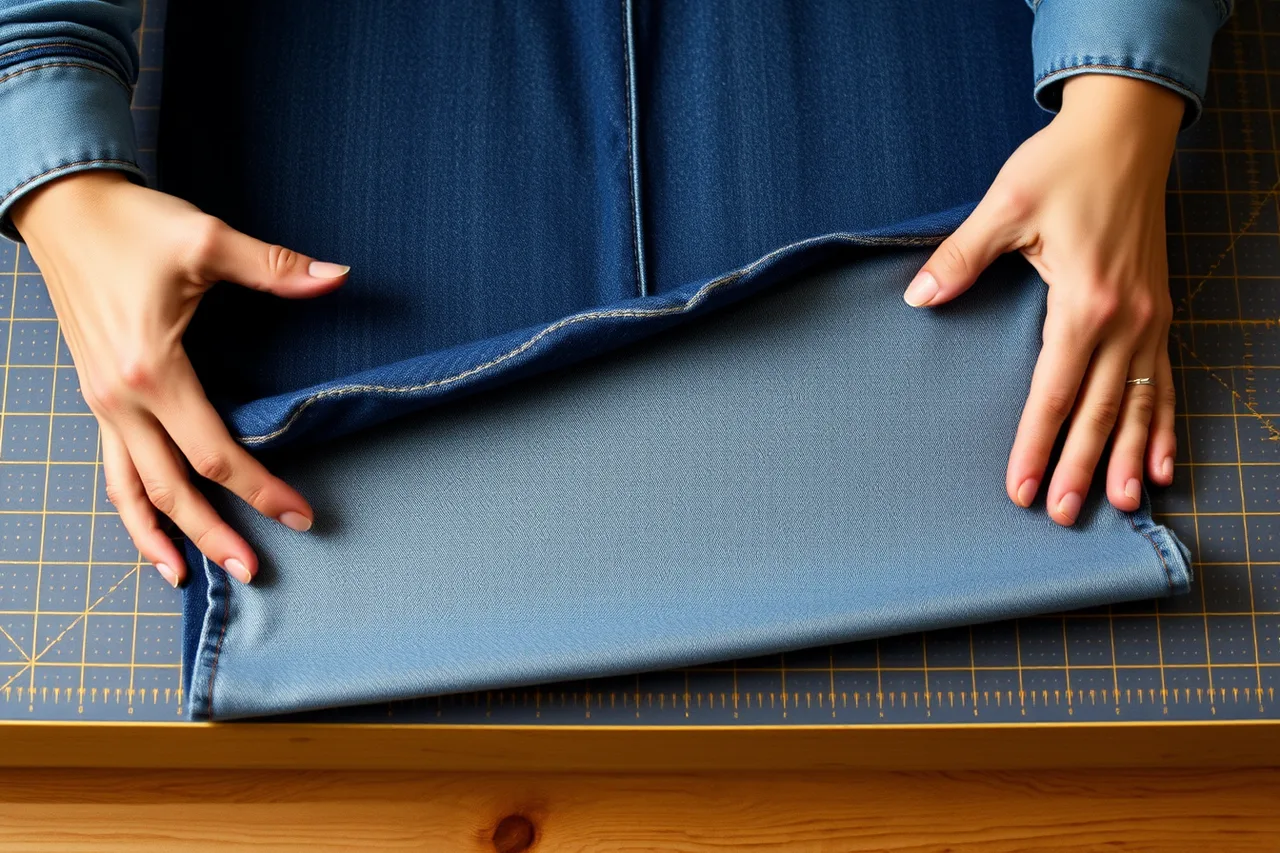
The quickest test is to pull both fabrics across the width and watch which one gives first. If the garment stretches noticeably and the patch does not, look for a different patch before you cut anything.
Color, and why it never quite matches
New indigo denim is darker than anything already in your wardrobe, and it stays darker for a long time.
Two practical options: accept the contrast and make it deliberate, or use a donor pair of similar age. Trying to match new denim to old is the route to a patch that looks like a mistake for two years.
Thread: fiber, weight and color
Polyester and core-spun polyester are the standard for jean seams. Both resist abrasion, hold color through repeated washing and cope with stretch. Core-spun thread wraps a polyester core in a cotton or polyester outer.
Thread is sized by Tex number, the weight in grams of 1,000 meters, or by the older ticket and gunze counts. Bigger Tex means thicker thread. All-purpose spools such as Coats Dual Duty XP and Mettler Metrosene usually run Tex 25 to Tex 35.
Denim seams usually take Tex 40 to Tex 60, and topstitching runs heavier, often Tex 70 to Tex 105.
Guetermann Mara 70 is a polyester thread sold for denim and heavy seams; by Guetermann's ticket system it sits near Tex 40, and lower ticket numbers mean heavier thread. Coats Extra Strong and Guetermann Top Stitch sit at the heavy end and need a bigger needle.
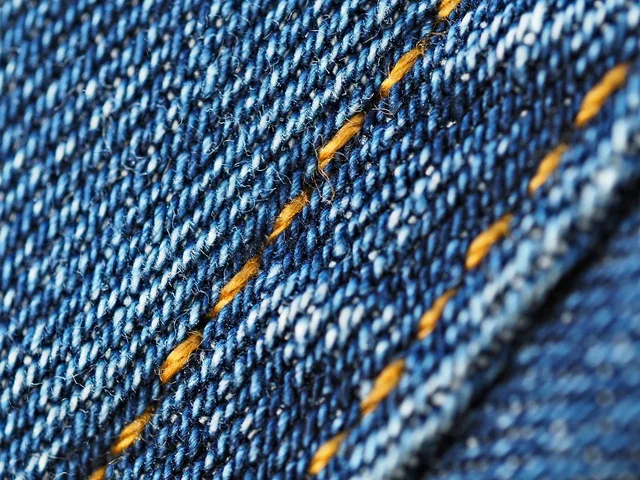
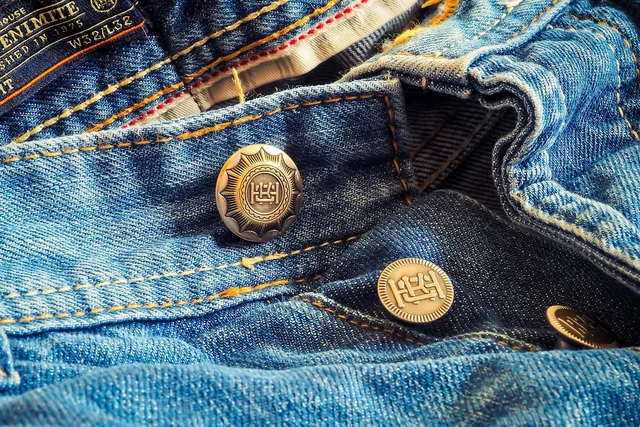
Topstitching on classic five-pocket jeans is gold, amber or copper. Buy topstitching thread in one of those shades when you want the repair to read as stitching.
For a repair that disappears, match the thread to the faded denim around the hole, one shade darker, not to the original indigo.
Needles and stitch length
Heavy thread needs a needle to match. Schmetz Denim needles come in 90/14, 100/16 and 110/18, with a reinforced blade and a larger eye; a pack of five typically costs $5 to $9.
Use 90/14 for standard denim and step up to 100/16 or 110/18 where seams cross or the fabric is heavy. Set stitch length near 3 mm, about 8 stitches per inch.
Pocket bags and linings are a different fabric
Pocket bags are usually a light plain-weave cotton, and labels disclose them separately for a reason. The rule on products containing linings, interlinings, fillings and paddings requires the fiber content of those components to be set out separately and distinctly.
That applies when the parts are included for warmth rather than structure, or when a claim is made about their content.
For repair, treat a pocket bag as its own garment. Replace it with light cotton, not with denim, or the bag will wear a hole in the jeans from the inside.
Why blends never match exactly
Even a donor pair with an identical label will differ a little. The rule on fiber content tolerances allows actual percentages to vary from the stated ones by up to 3 percent of total fiber weight.
That is a small difference on paper and a visible one after ten washes, which is another argument for a deliberate contrast rather than an attempted match.
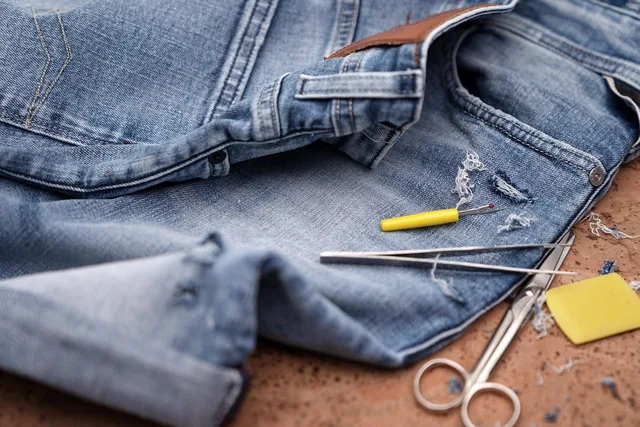
Once the material is chosen, the method usually picks itself, and the kit is short enough to assemble in one trip.