Reviews
Part of Planning a clothing repair before the scissors come out: four checks
A patch fabric and thread guide for a clothing repair that lasts
Matching patch fabric and thread to a garment: fiber, weight, shrinkage and what the label's cleaning instruction legally commits the repair to surviving.
Material choice is where a repair is decided. A well-stitched patch in the wrong fabric fails; a mediocre patch in the right one lasts for years. Three properties matter, in this order: fiber, weight, and how much the material has already shrunk.
What to take away
- Match fiber first. Cotton on cotton, wool on wool, and a blend to its dominant fiber.
- Match weight second. A patch heavier than the garment concentrates stress at its edge.
- Prewash patch fabric at the garment's own wash temperature, or the patch will shrink later.
- Thread should be no stronger than the fabric. Thread stronger than cloth tears the cloth instead of breaking.
Fiber, and what the label commits you to
The care instruction on a garment is a legal claim about how the item can be cleaned, and the definitions behind it are specific. The definitions in the care labeling rule state that drycleaning means a commercial process using an organic solvent.
Care Label Conditions
- 75%max relative humidity in drycleaning
- 160°Fmax hot tumble drying
- 145°Fmax machine wash water
That process may include moisture up to 75 percent relative humidity and hot tumble drying up to 160 degrees F. Machine wash, where no temperature is given, means hot water up to 145 degrees F may be used regularly.
Those numbers are the environment your patch has to live in. A patch fabric that has never seen 145 degree water, on a garment that gets it weekly, will shrink and pucker within a month.
Weight and structure
Patch that works
- Jersey t-shirt
- Soft knit, similar stretch
- Oxford shirt
- Same-weight woven cotton
- Denim jeans
- Lighter denim or twill
- Wool sweater
- Wool yarn or knit fabric
Patch that fails
- Jersey t-shirt
- Woven cotton
- Oxford shirt
- Heavy canvas
- Denim jeans
- Stiff new denim
- Wool sweater
- Cotton woven
The rule underneath the table is that the patch should be equal or slightly lighter than the garment. Slightly lighter flexes with the cloth. Heavier acts as a rigid plate, and the garment tears along the edge where movement stops.
Patch Match by Garment
Garment
- Jersey t-shirt
- Soft knit, similar stretch
- Oxford shirt
- Same-weight woven cotton
- Denim jeans
- Lighter denim or twill
- Wool sweater
- Wool yarn or knit fabric
Patch that works
- Jersey t-shirt
- Woven cotton
- Oxford shirt
- Heavy canvas
- Denim jeans
- Stiff new denim
- Wool sweater
- Cotton woven
Patch that fails
- Jersey t-shirt
- Oxford shirt
- Denim jeans
- Wool sweater
Where the patch fabric comes from
Cut it from a garment of the same kind that has already been washed many times. That material has done its shrinking and its fibers have relaxed to their final state. New fabric off a bolt has not, which is why prewashing is not optional.
Before cutting a donor garment, check what it contains. The National Park Service leaflet on dry cleaning museum textiles sets out the examination a textile gets before cleaning.
The questions transfer directly to choosing a donor: how is it constructed, does it contain more than one type of fabric, what is the fiber content of each component, are the fabrics dyed, and are there attached embellishments. A donor shirt with a different fiber in the yoke will give you two different patches from one garment.
Thread
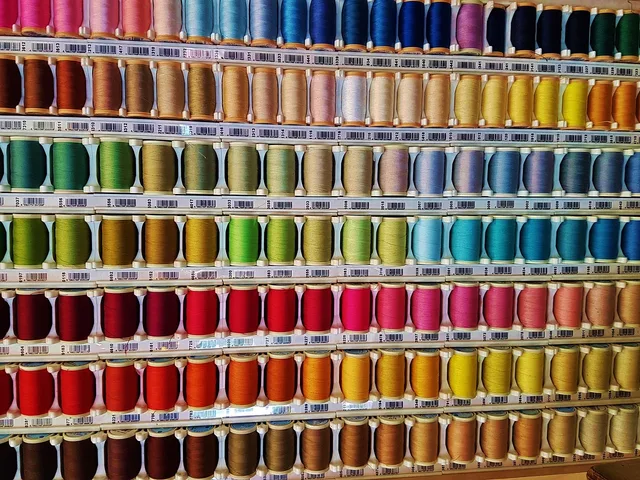
Match the thread fiber to the fabric fiber, and keep the thread no stronger than the cloth. Polyester thread on a worn cotton shirt is a common mistake: the thread holds while the aged cotton tears along the stitch line.
Cotton thread on cotton fails first, which is the outcome you want. A failed thread is a re-stitch; a torn garment is not.
Choosing well is easier once the finish is decided, and material that is going to sit for months should follow the storage rules for patch stock.