Reviews
Part of Sweater mending how it works: a step-by-step guide
Hoop versus flat support for sweater mending, compared honestly
Work surfaces for knitwear repair: why knits need a flat unstretched support rather than a hoop, what to put under a sweater while you work, and why the floor.
Knitwear repair fails on the wrong surface more often than in the wrong technique. A knit stretched while you stitch contracts afterwards, and the darn ends up tight and puckered in a garment that hangs correctly everywhere else. The surface is the fix.
What to take away
- Never work a knit under tension. That rules out embroidery hoops for anything but the loosest gauge.
- Support from underneath with something rounded and firm, so the fabric rests rather than stretches.
- Work where you can see and reach the back of the fabric, because a knitted repair is judged from both sides.
- Do not work on carpet. It is where fabric pest larvae live.
Hoop versus support
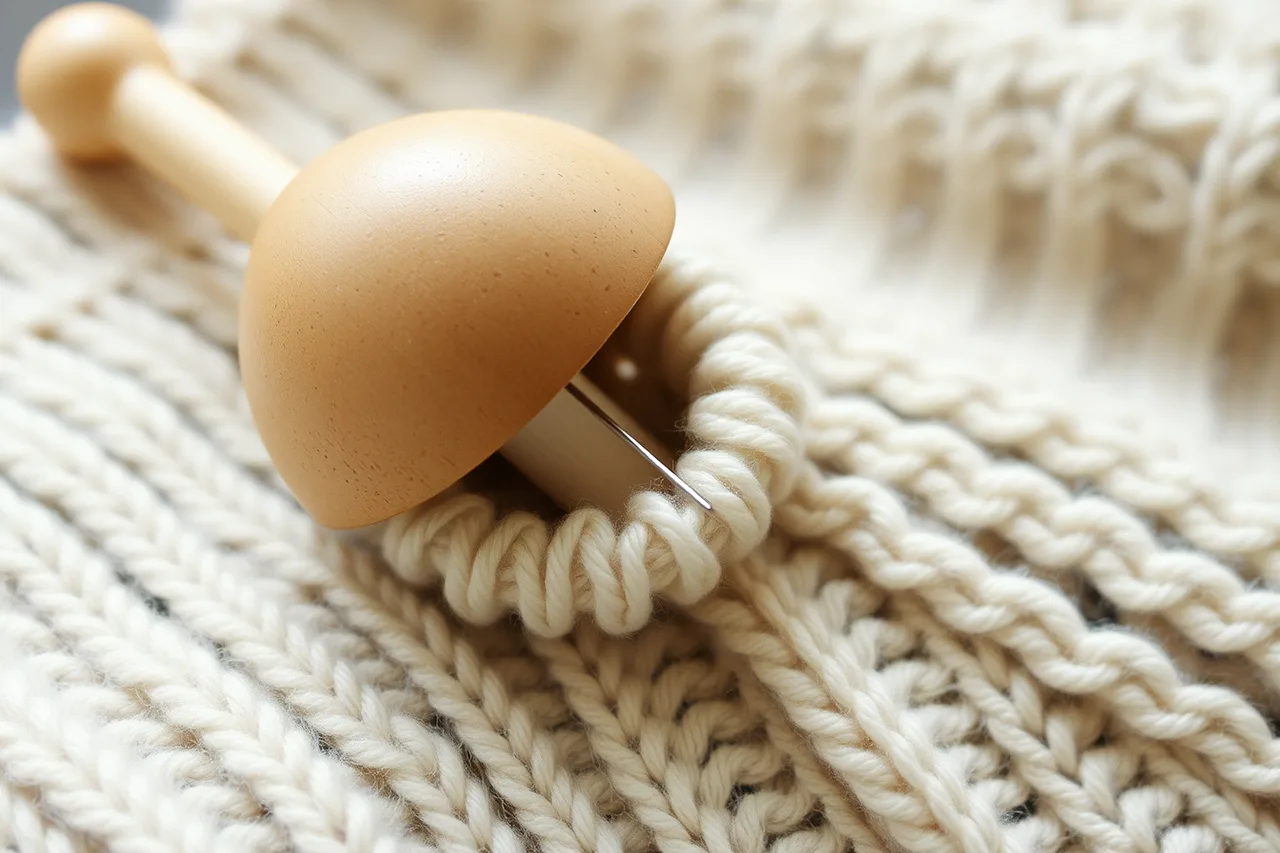
An embroidery hoop holds woven fabric flat under slight tension, which is exactly what a woven darn needs and exactly what a knit cannot take. Under a knit, use a rounded support instead: a darning mushroom, a smooth wooden egg, a tennis ball in a clean sock, or a firmly rolled towel.
Hoop vs knit supports
Hoop
- Good for
- Wovens, firm fabric
- Problem
- Stretches knits
Darning mushroom
- Good for
- Small knit holes
- Problem
- Limited to its curve
Rolled towel
- Good for
- Large awkward areas
- Problem
- Shifts if unsecured
Flat padded board
- Good for
- Blocking, inspection
- Problem
- Not for working inside
Good for
- Hoop
- Wovens, firm fabric
- Darning mushroom
- Small holes in knits
- Rolled towel
- Large or awkward areas
- Flat padded board
- Blocking and inspection
Problem
- Hoop
- Stretches knits
- Darning mushroom
- Limited to its own curve
- Rolled towel
- Shifts if not secured
- Flat padded board
- Not for working inside
Judge from both sides
A repair that looks acceptable from the front but messy from the back will not last. Loose ends on the reverse abrade against the body and work free. Set up so you can turn the work over easily.
Turning the work over also shows whether your patch fabric and thread match the garment, which the patch fabric and thread guide covers.
Fiber arts judging has the same standard. The Oregon 4-H fiber arts exhibit guidance states that each article should be finished completely, front and back, for final use, and classifies exhibits by technique rather than by article. That is a fair benchmark to hold a repair to: finished front and back, judged as the technique you actually used.
Why not the carpet
Spreading a sweater on the floor to work is common and a bad habit for one reason. Ohio State extension's fact sheet on carpet beetles says these beetles feed on wool, fur, feathers, hair, hides, silk, velvet and felt.
The larvae cause the damage while living behind baseboards and molding. They also live in carpets, drawers, clothing and furniture, and feeding damage often occurs under heavy furniture and at carpet edges.
So the floor next to a skirting board, under a sofa, is one of the likeliest places in a home to pick up larvae, and a wool sweater left there while you fetch a cup of tea is an invitation.
A workable setup
A padded board sits on a table at forearm height. A darning support rests in a small bowl so it does not roll away.
A task lamp sits to the side, and a light-colored cloth under the work makes dropped stitches and yarn ends visible.
The technique that surface supports is set out in the full sweater repair sequence, and the general surface and light choices apply here too, with the tension rule laid on top.