Reviews
Part of Which creative mending ideas fix which problems
Work surfaces for creative mending, compared by light and height
Work surfaces and light for mending at home: choosing a surface height, a support board that keeps fabric flat, and light placement that shows stitch tension.
Work surfaces for creative mending get judged twice: by the height they put your hands at and by how they take light. Mending happens on whatever surface is nearest, which is usually a sofa and a knee.
That works for a button and fails for anything that has to stay flat. The surface and the light do more for the result than any tool purchase.
What to take away
- Flat and firm beats large. A two foot square of rigid board is enough for most repairs.
- Height matters more than area. Working below elbow height for an hour is what makes mending feel like a chore.
- A padded support board keeps fabric flat without pinning it to a table.
- Light should come from the side, not from behind your head.
What the surface has to do
Three things: hold fabric flat, resist a needle without dulling it, and not stain the garment. A dining table does the first two and fails the third if anything gets spilled. A portable board solves all three and can be put away.
Named surfaces show the trade-offs. The table below compares eight named products and two baselines by height, flatness and light needs.
Flatness
- IKEA BEKANT sit/stand desk
- Good
- Uplift V2 standing desk
- Good
- Husky 46 in. mobile workbench
- Good
- Arrow Gidget sewing table
- Good
- Fiskars 18x24 self-healing cutting mat
- Good
- OLFA 24x36 self-healing cutting mat
- Good
- Grace Company Quilter's Cut 'n Press
- Good
- June Tailor Quilter's Cut 'n Press
- Good
- Dining table
- Good
- Lap
- Poor
Portable
- IKEA BEKANT sit/stand desk
- No
- Uplift V2 standing desk
- No
- Husky 46 in. mobile workbench
- Yes, on casters
- Arrow Gidget sewing table
- Yes
- Fiskars 18x24 self-healing cutting mat
- Yes
- OLFA 24x36 self-healing cutting mat
- Yes
- Grace Company Quilter's Cut 'n Press
- Yes
- June Tailor Quilter's Cut 'n Press
- Yes
- Dining table
- No
- Lap
- Yes
Watch out for
- IKEA BEKANT sit/stand desk
- 22 to 48 in.; add a side lamp; around $600
- Uplift V2 standing desk
- 25.5 to 51.1 in.; best for tall menders; starts near $700
- Husky 46 in. mobile workbench
- 37.5 in. fixed; too high seated
- Arrow Gidget sewing table
- 28.5 in.; folds away; light from left
- Fiskars 18x24 self-healing cutting mat
- Sits on table; needle grooves over time; about $25
- OLFA 24x36 self-healing cutting mat
- Sits on table; cold and slippery; $60 to $80
- Grace Company Quilter's Cut 'n Press
- Padded top, keeps fabric flat; wash cover
- June Tailor Quilter's Cut 'n Press
- 12x12, small for garments; about $25
- Dining table
- About 30 in.; finish marking, spills
- Lap
- Low; fine for buttons only
Building a padded support board
The museum version of this is simple and worth copying. The National Park Service leaflet on a simple storage mat for textile fragments starts from the same principle a mender needs: textiles are flexible and need an auxiliary support. A sturdy archival corrugated board covered with washed cotton fabric is enough to handle a textile on.
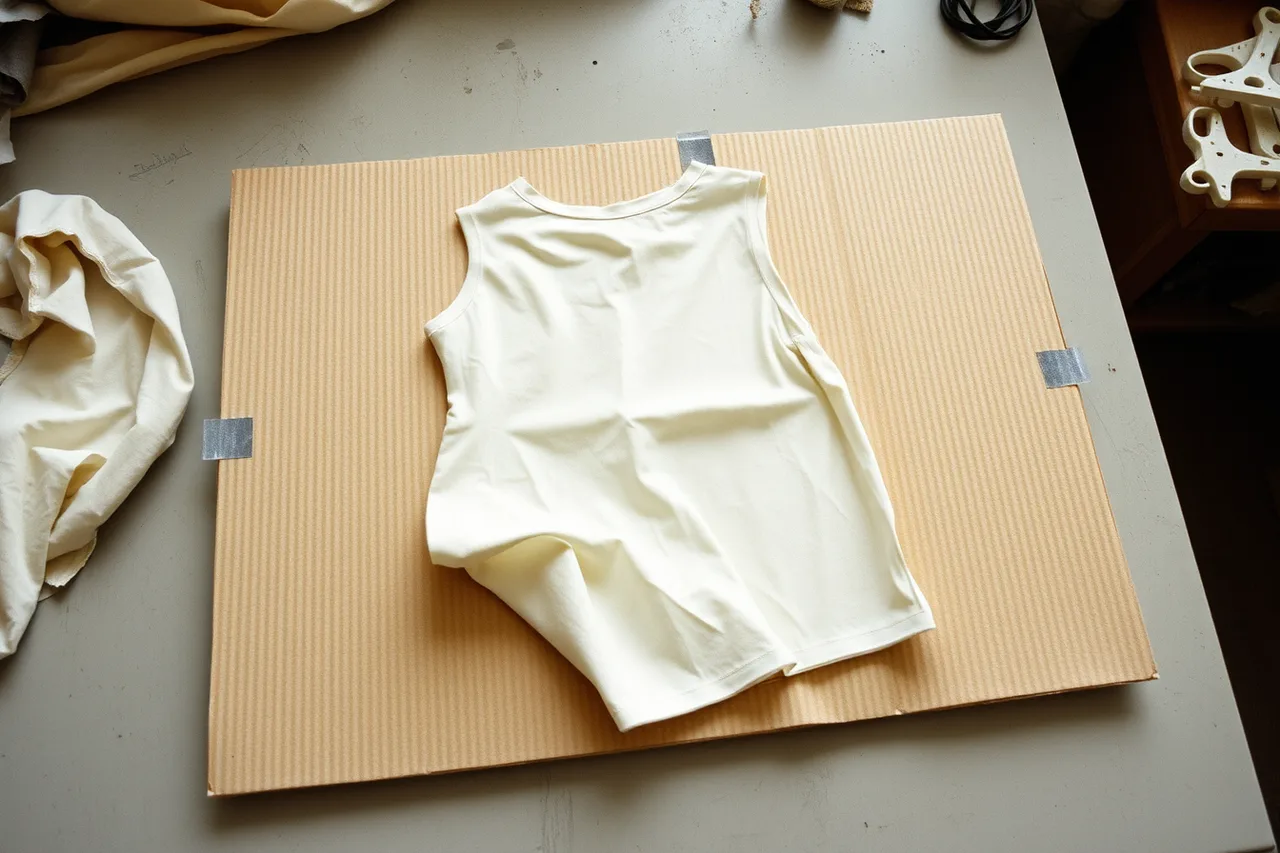
It goes on to describe a hinged mat built from 4-ply board cut six inches longer and wider than the object, with two inch strips forming a window.
For mending, stop at the covered board. Cut rigid board slightly larger than your usual garment area, wrap it in washed cotton, and staple or tape the cotton on the back.
Grace Company Quilter's Cut 'n Press and June Tailor Quilter's Cut 'n Press are ready-made versions, both around $25 to $40. Washed cotton matters because new fabric releases sizing and can transfer it.
Light
Light does two jobs and one of them is unwelcome. It lets you judge stitch tension, and it degrades the garment while you work.
Museum practice takes the second part seriously. The National Park Service chapter on the museum collections environment states plainly that light damage is irreversible and cumulative. Ultraviolet radiation is the most damaging part of the spectrum, although visible and infrared also cause damage, and the target is to eliminate UV with emissions below 10 microwatts per lumen.
It also notes that infrared raises object temperature and speeds chemical reactions, which is why a hot lamp close to fabric is a bad idea.
The practical version for a home bench: an LED task lamp positioned to one side, close enough to rake across the surface, and switched off when you stop. Do not work under a window in direct sun.
Named lamps make the choice concrete. OttLite Wellness Series LED desk lamps run about $50 to $100 and stay cool. Dazor Stretch View LED lamps cost around $300 and clamp to a desk.
BenQ e-Reading LED desk lamps sell near $200 and adjust from 2700K to 6500K. IKEA JANSJÖ LED work lamps cost about $15 and clamp anywhere. Daylight Company Uno LED lamps run around $60.
Height and seating
Set the surface so your forearms are level when your hands are on the work. For most people that is higher than a dining table and lower than a kitchen counter. If you cannot change the table, change the chair, then put a cushion under the work rather than hunching over it.
This is the part of the setup worth getting right first, before any of the mending ideas are worth attempting, and it constrains everything in a small space arrangement.