Guides
Opening purchases for a sewing repair business: records and tagging before tools
The opening purchases for a sewing repair business, in order: records and tagging before tools, tools before stock, and stock before anything measured for sale.
What to take away
- Buy the record system before the tools. Untracked customer property is the real risk.
- Parts stock is where new shops lose money. Buy on demand for the first year.
- If you sell anything by length or weight, the measuring device is regulated equipment.
- Altering or relabeling garments brings labeling obligations with it.
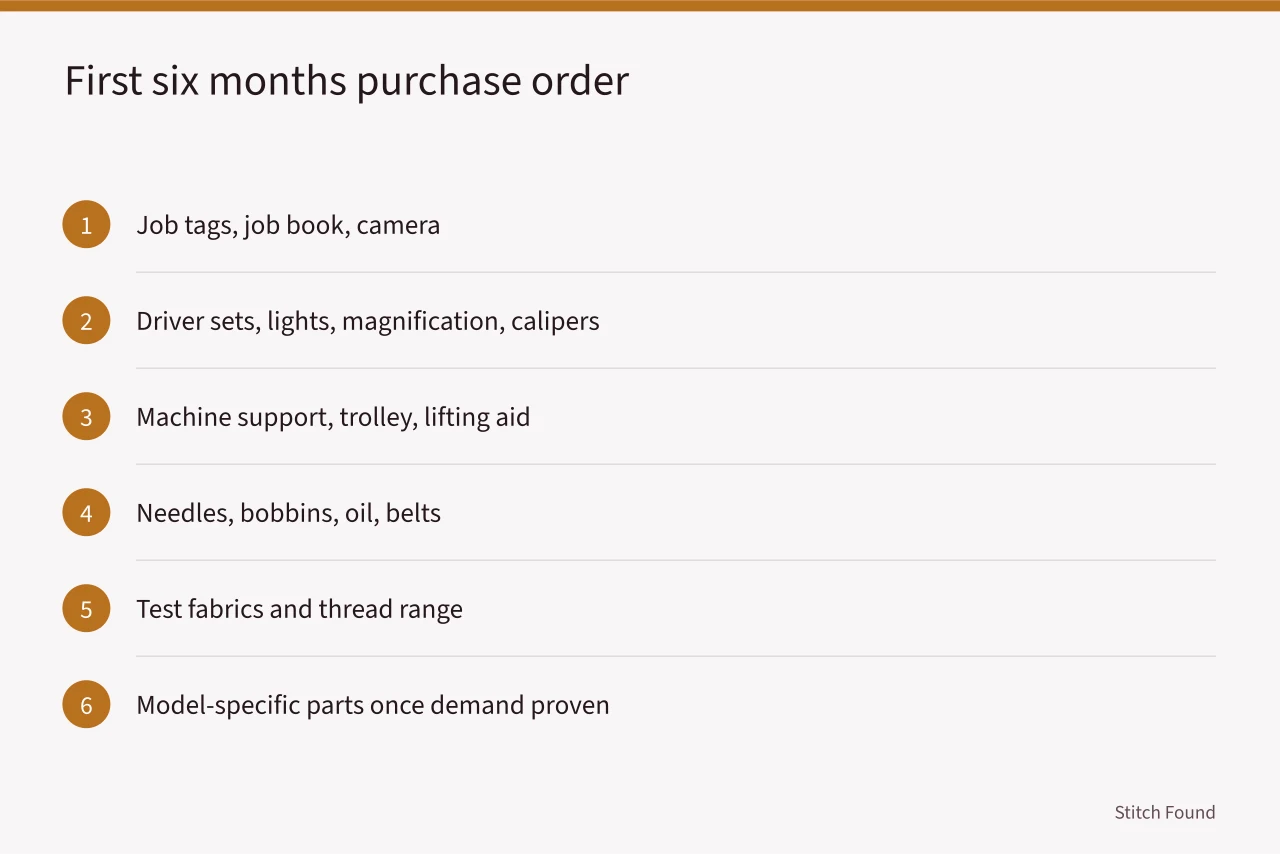
Purchase order for the first six months
| Stage | Buy | Why now |
|---|---|---|
| 1 | Job tags, job book or software, camera | Nothing enters without a record |
| 2 | Driver sets, lights, magnification, calipers | The tools every job needs |
| 3 | Machine support, trolley, lifting aid | Heads are heavy and staff are not replaceable |
| 4 | Common consumables: needles, bobbins, oil, belts | Predictable demand |
| 5 | Test fabrics and thread range | Testing under load is the deliverable |
| 6 | Model-specific parts | Only once demand is proven |
The temptation is to reverse this list and start with an impressive parts wall. Stock bought speculatively for machines nobody brings in is money on a shelf.
Stage three surprises people. Lifting is the injury that closes a one-person shop, and a trolley that takes a treadle cabinet costs less than a week of not working. Buy it before you need it, because the day you need it is the day you are already carrying something.
Measuring devices are regulated equipment
Shops that sell thread, elastic, interfacing, zips by the meter or fabric by weight are trading by measure, and that has its own rules. NIST's national legal metrology program promotes uniformity across national, state and local levels in the laws, regulations and practices governing weighing and measuring instruments, in order to facilitate trade and protect businesses and consumers.
The practical version: a scale or measure used for trade is not the same purchase as one used in your kitchen, and local weights and measures officials are the people to ask before buying, not after.
Labeling obligations follow alteration work
An alterations business that replaces a lining, remakes a garment or sells anything it has made is stepping into textile labeling territory. Fiber content rules for wool products, for example, sit in the regulations under the Wool Products Labeling Act, which set out how such products must be identified.
Straight repairs to a customer's own garment are a different situation from manufacturing for sale. Knowing which side of that line a job sits on is worth ten minutes before you take the work.
Do not buy these in year one
- A large parts inventory for machines you have not been asked to fix.
- Industrial machines to service, before an industrial customer exists.
- Custom branded packaging.
- A second premises worth of shelving.
- Anything sold as a complete business starter package.
The common thread is that each one commits money to a version of the business you have not yet proved exists. Wait until customers have told you what they bring in, then buy for that, which is usually narrower and duller than the business you imagined.
Tools that carry across everything
The bench kit for a business is the same one a serious hobbyist owns, bought in better quality and duplicated so two jobs can run without hunting for a driver. The list is set out in our first purchases article for restoration, and which of the business models you have chosen determines what gets added on top.